

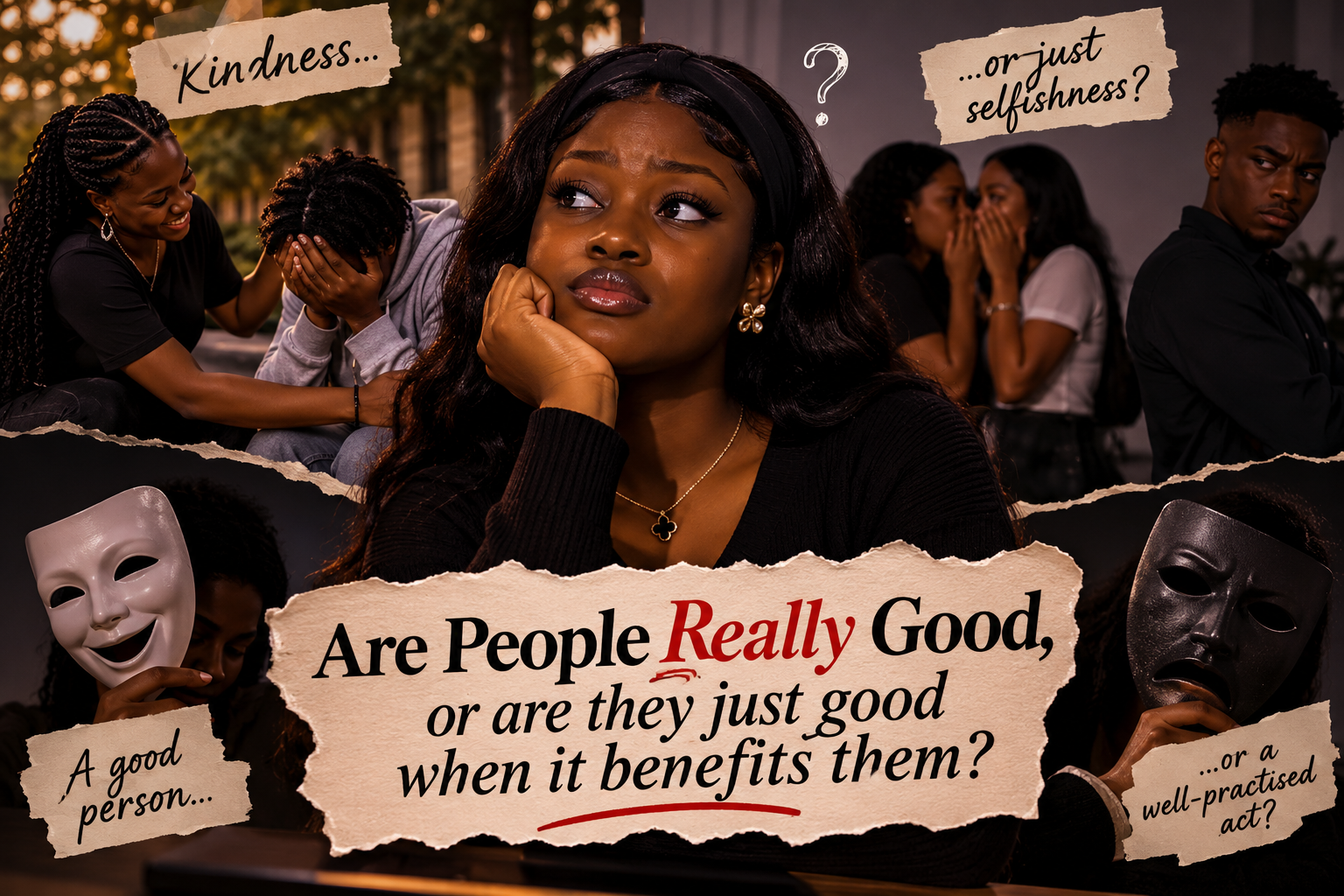
Introduction: The uncomfortable question
Let's be honest: have you ever wondered whether the people around you are genuinely good people or simply people who have never had a reason to show you otherwise?
It's an uncomfortable thought, but perhaps one worth entertaining.
We grow up being taught that kindness is a virtue, honesty is a principle, loyalty is a choice and goodness is something we should practise regardless of what we stand to gain.
But here's where things get interesting:
What happens when doing the right thing costs you something?
Would someone still defend you if standing up for you meant losing their popularity? Would a friend remain loyal if betraying your trust offered them an opportunity? Would someone help you if they knew, without a doubt, that you could never repay them?
And perhaps the most uncomfortable question: Would you?
The psychology behind our kindness
We love to believe that we're good people. We pride ourselves on the times we've helped others, the secrets we've kept, the sacrifices we've made and the kindness we've shown.
But how often do we examine our intentions?
Sometimes, we help because we genuinely care. Other times, we help because we want to feel needed, appreciated or remembered.
Sometimes, we forgive because we've found peace. Other times, we forgive because we're afraid of losing someone.
Does that make our goodness any less genuine?

Is every good deed selfless?
There's an interesting distinction in moral philosophy between altruism and self-interest.
Altruism involves acting out of concern for another person's well-being, while selfishness places one's own interests first.
However, human motivations can be mixed. Someone can genuinely want to help another person while also enjoying the satisfaction that comes from doing something good.
Perhaps goodness isn't always as simple as we make it seem.
When kindness becomes conditional
Think about it.
Some people are kind because they understand what it feels like to be treated poorly. Others are kind because they expect kindness in return.
Some people are generous until they realise their generosity isn't being acknowledged. And some people will go out of their way for you, not necessarily because they love you, but because they enjoy being seen as the person who always comes through.
Then there's another uncomfortable reality: sometimes, people don't change. You simply experience a version of them that you hadn't encountered before.
The friend who once defended you might eventually become the person gossiping about you.
The person who promised never to leave might become a stranger.
The individual who preached honesty might be the very person who teaches you how convincing a lie can sound.
And suddenly, you're questioning everything.
Are we all secretly selfish?
The uncomfortable mirror
It's easy to examine other people's intentions. It's much harder to examine our own.
Have you ever helped someone and secretly expected them to return the favour?
Have you ever been nice to someone because you needed something from them?
Have you ever apologised because you genuinely regretted your actions, or simply because you wanted the argument to end?
These questions aren't accusations. They're invitations to self-reflection.
Perhaps the problem isn't that people are secretly terrible. Maybe it's that human beings are complicated, and our intentions aren't always as pure as we'd like to believe.
But do genuinely good people still exist?
I don't think we should conclude that nobody is genuinely good.
There are people who do wonderful things without announcing them.
People who show up when there's nothing to gain. People who remain honest even when dishonesty would be easier. People who choose compassion even when nobody is keeping score.
They exist.
However, I think we've made a mistake by assuming that being a good person means being incapable of selfishness, jealousy, dishonesty or disappointment.
Perhaps goodness isn't the absence of bad impulses.
Perhaps it's the willingness to recognise them, take responsibility for them and choose better even when choosing better is difficult.
After all, nobody is perfect. Not you, not me, not the person you admire most.
And maybe that's precisely why we should be careful about placing people on pedestals.
So, what actually makes someone a good person?
Maybe it's not about never making mistakes.
Maybe it's about what happens after the mistake.
Do you take responsibility? Do you acknowledge the damage you've caused? Do you make an effort to change, even when nobody is demanding an explanation?
Don't confuse someone's kindness with a guarantee that they'll never hurt you. Don't mistake someone's generosity for proof that they have no selfish intentions.
But equally, don't allow a few disappointing experiences to convince you that genuine goodness no longer exists.
We can acknowledge that people have complicated motives without assuming that every act of kindness is manipulation.
The final question: Are you as good as you think you are?
Perhaps the answer is more complicated than either option.
But I'd love to hear what you think.
Would you still consider someone a good person if they only did the right thing when it benefited them?
Can an act of kindness still be genuine if the person performing it also benefits emotionally?
And more importantly, if we examined our own actions as closely as we examine other people's, how many of us would pass the test?
Perhaps the real question isn't whether good people exist. It's whether we're brave enough to examine the kind of people we are when there's absolutely nothing to gain.