

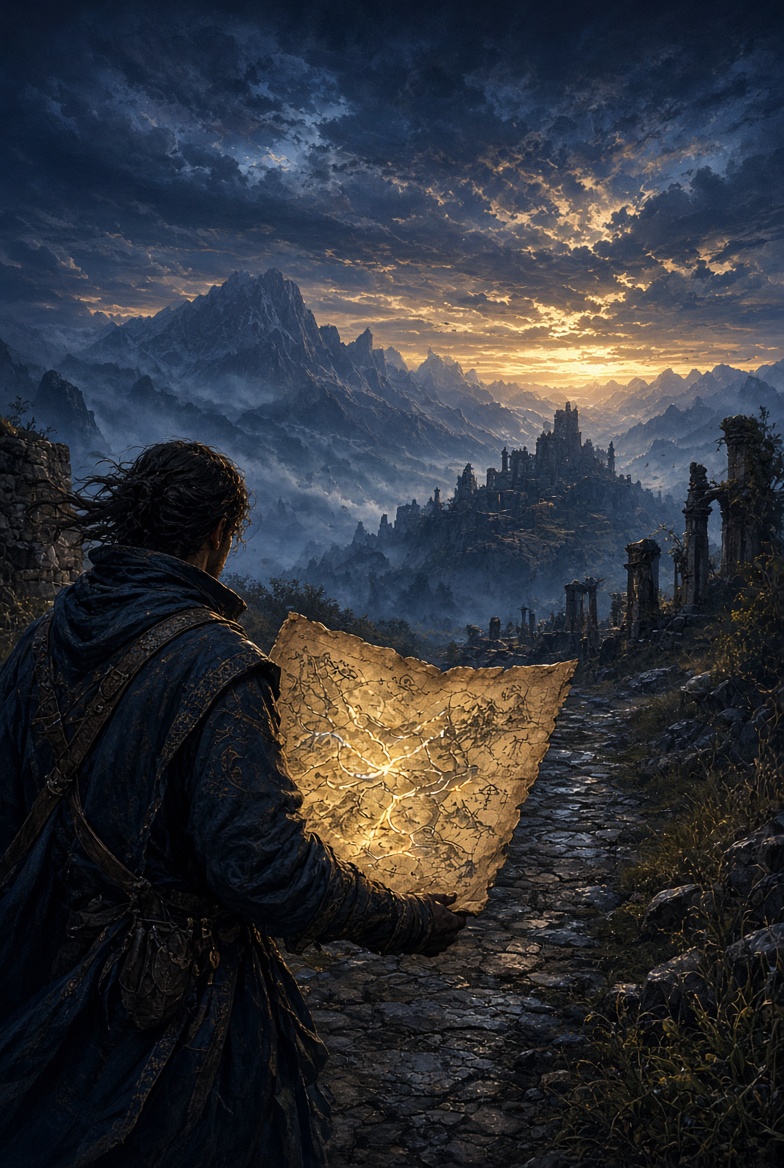
**The Cartographer of Forgotten Roads**
In the year when the maps of the world began to fade, Elara Voss discovered that paper remembered what people forgot.
She lived in a narrow apartment above a shuttered print shop in the old quarter of the city, where the streets still carried names no one used anymore. By day she restored damaged atlases for private collectors. By night she traced the blank spaces that appeared in even the newest digital charts—those pale, stubborn voids where roads should have been, or rivers, or the outlines of villages that satellites somehow refused to acknowledge.
One rainy Thursday she found a map that did not belong to any collection.
It arrived inside a plain manila envelope with no return address, only her name written in ink that smelled faintly of rain and iron. The paper was thick, cream-colored, and when she unfolded it the creases whispered like old cloth. The map showed a region that did not exist on any modern projection: a long, serpentine valley called the Hollow of Thorns, bordered by mountains whose names had never appeared in any gazetteer. A single road wound through it, marked in faded red, and at its end stood a symbol she had never seen before—a small open circle with a single vertical line rising from its center, like a path that refused to end.
Elara spent three days cross-referencing. Nothing. No historical records, no satellite anomalies, no local legends that matched. On the fourth night she packed a small bag, left a note for the landlord that said only “Back when the map is finished,” and boarded a train north.
The valley was real.
It waited beyond the last marked highway, past a stretch of scrubland where the GPS signal died without ceremony. The road appeared exactly where the map promised, a narrow track of packed earth and pale stones that seemed to glow faintly under the moon. Thorn bushes crowded its edges, their branches heavy with dark berries that never quite ripened. The air smelled of wet stone and something sweeter, like crushed mint and distant woodsmoke.
She walked for two days. On the second evening the road began to change. The stones underfoot grew smoother, almost polished. Tiny carvings appeared along the verges—spirals, open circles, short vertical lines. Sometimes she thought she heard voices just beyond the range of hearing, the soft murmur of people who had once traveled this way and left their conversations behind like footprints.
At dusk on the third day the road ended at a wide, shallow basin of white sand. In the center stood a single stone post, waist-high, capped with an open circle of dark metal. The vertical line was a slender rod of the same material, rising from the circle’s heart and pointing straight up into the darkening sky.
Elara approached. The air around the post felt warmer. When she touched the metal, a low vibration passed through her palm and into her chest, as though the earth itself had exhaled.
Then the map in her satchel grew warm.
She drew it out. The red road was no longer red. It had turned a soft, living gold, and the open-circle symbol at its end now pulsed gently, once every few seconds, like a slow heartbeat. New lines began to appear on the paper—faint at first, then clearer—branching outward from the basin in every direction. Some led to places she recognized. Most did not. One thin golden thread curved north and west, vanishing off the edge of the page toward a region the modern world still insisted was empty.
A soft voice spoke behind her, though no one stood there.
“You found the first one.”
Elara turned. The valley remained empty. The thorns stirred in a wind that did not reach her face.
“There are others,” the voice continued, gentle and tired and somehow familiar. “The old roads never disappeared. They only waited for someone who still knew how to read the blank spaces.”
She looked down at the map. The golden lines continued to spread, slow and certain. In the lower corner, in the same careful hand that had written her name on the envelope, new words appeared:
*Keep walking. The world is larger than they told you.*
Elara folded the map carefully, placed it against her heart, and stepped past the stone post onto the white sand. Behind her the old red road faded from the paper. Ahead, the new paths shone.
She did not look back.
Somewhere far beyond the mountains, other blank spaces waited to be filled. And for the first time in a very long while, the cartographer of forgotten roads smiled, because the work had only just begun.