

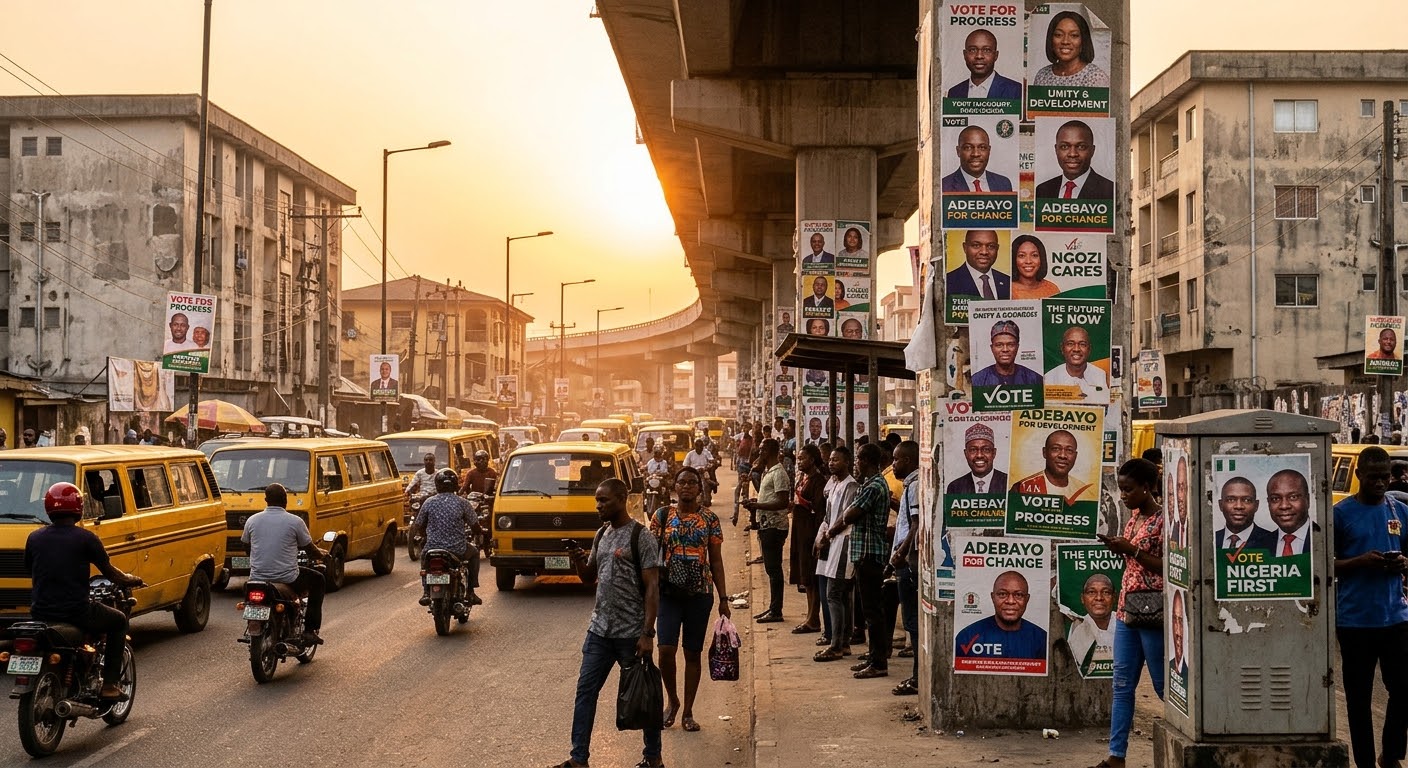
A city saturated in posters. Hearts heavy with hope. Journey with Amina as she prepares to cast the vote that defines a generation in Port Harcourt.
Voices of Tomorrow: A City Awaits the Vote
The Rising Tide of Color and Sound
The air in Port Harcourt was already thick with the humidity of the approaching rainy season, but another kind of heat was building—the electric energy of the upcoming election. For twenty-two-year-old Amina, this cycle felt different. In previous years, elections had been noisy backdrops to her exams, but this time, the posters pasted over every available surface—from the concrete pillars of the flyovers to the rusted gates of the market—featured faces claiming to hold her future.
The city had become a battlefield of slogans. Huge billboards dominated major junctions, flashing smiling candidates promising everything from constant power to jobs for all graduates. Beneath them, yellow minibuses (danfos) fought for space, their drivers often wearing matching campaign t-shirts, not out of conviction, but convenience.
Amina watched a convoy sweep past the university gate, a tangle of SUVs, security, and blaring loudspeakers. "Forward Nigeria!" the voice cried. She looked down at her own voter’s card, held tightly in her palm. The plastic felt lightweight, yet impossibly heavy with implication.
*Image Description: The golden hour in Port Harcourt sees streets plastered with overlapping campaign posters (fictional names and slogans) as yellow minibuses navigate the election tension.*
Hopes and Hesitations
In Mile 3 market, the conversation was raw. Amina often bought roasted plantain (boli) from Mama Ngozi, a woman whose face was mapped with the lines of hard work. Today, Mama Ngozi wasn't smiling as she fanned the coals. A politician's representative had visited the market earlier, distributing small bags of rice.
Amina listened as Mama Ngozi argued with a neighbor.
> "They come and go like the rain," Mama Ngozi said, gesturing with her fan. "They give us rice today, and then they disappear for four years. Does rice fix the roads? Does rice keep my children in school?"
>
Later that evening, Amina met Pa Adebayo, an elder in her community known for his sharp memory. His living room was quiet, lit by the blue glow of a rechargeable lamp. He spoke softly, reflecting on many previous transitions.
> "My child, democracy is like a tree," Pa Adebayo explained, resting his hands on his walking stick. "The tree we are watering now was planted long ago. If you want it to bear good fruit, you cannot wait for others to water it. You must stand in line, even if it is long, and pour your own bucket."
>
The skepticism was real, but the sense that this time, *something* might change was also present. The old ways were fighting the new, and Port Harcourt was caught in the balance.
*Image Description: A young Port Harcourt woman addresses a focused crowd at a community center rally, urging her peers to recognize the power of their vote.*
The Youth Collective
Determined to move beyond slogans, Amina joined a local youth voter education group. They gathered not to promote a candidate, but to explain the process.
Their first rally, held in a dusty community center courtyard, was initially small. But as the speakers found their voices, people began to gather. Amina took the megaphone, her heart pounding.
> "We are the 60 percent," she cried to the gathering crowd. "Our population is our power. If we refuse to be divided, if we refuse to sell our voice for rice, they must listen to us. We are not just waiting for the future; we are voting for it."
>
The energy shifted. Young people, usually dismissive of politics, began to ask questions—about security, about electronic transmission of results, about how to protect their votes. They were no longer passive observers of a spectacle. They were participants, ready to define the coming days.
The Night Before the Silence
As dusk fell on the eve of the election, Port Harcourt fell unusually silent. Campaign convoys vanished. The blaring speakers were mute.
Amina sat on her porch, listening to the generator’s hum. The noise and color of the campaign had faded, leaving only the quiet determination of a city waiting. She double-checked her bag: Voter’s Card, water, power bank. She would be at her polling unit at 6:00 AM, just as the sun broke.
The voices of yesterday—the skeptics, the hopeful elders, the fiery youth—all merged into a single truth. The road ahead was uncertain, but tomorrow, the path would be shaped by the millions like her, waking up early to cast their vote and define the Voices of Tomorrow.